
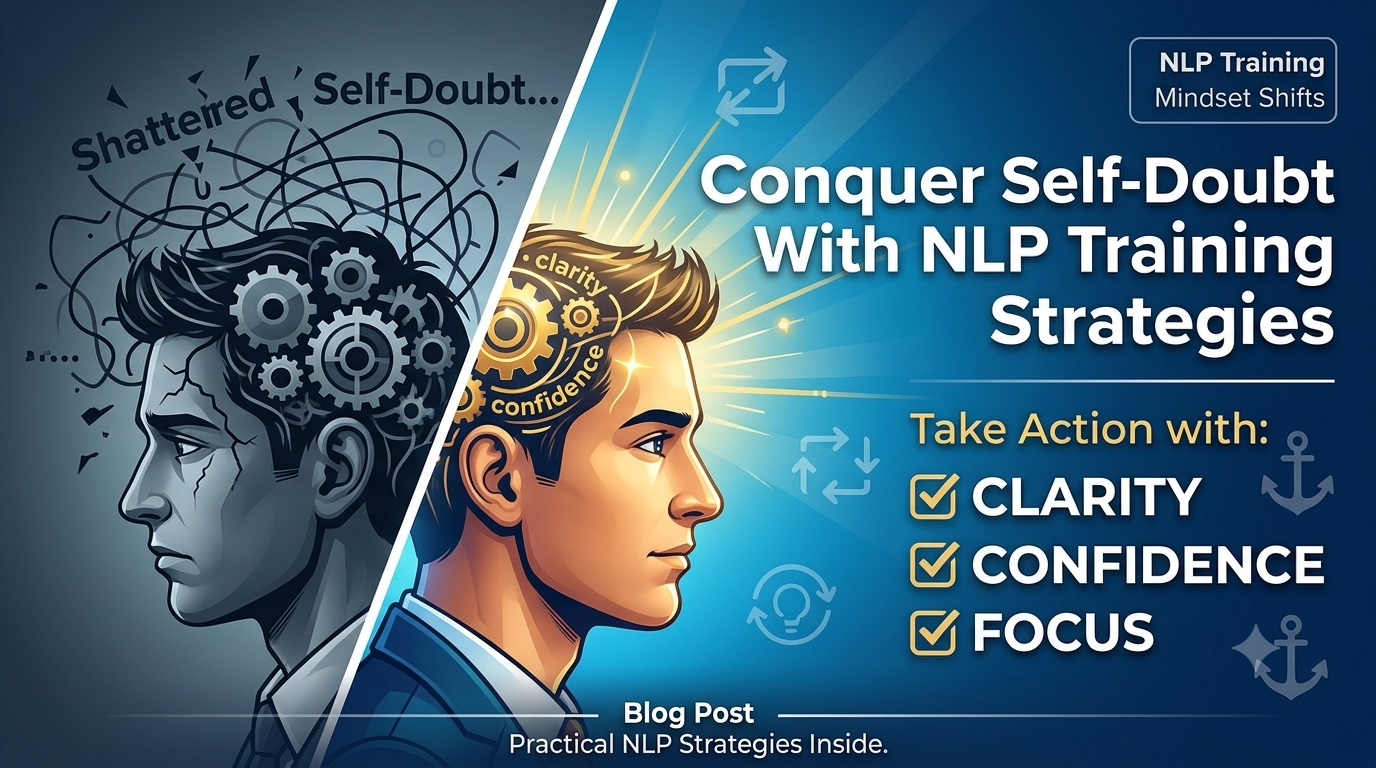
Reclaiming your confidence when your talent seems to reach a ceiling begins with one important reality: skill alone does not eliminate self-doubt. You can be the most capable person in the room and still experience hesitation, second-guessing, or a freeze response at the moment you need to step up. This is not a sign that you are broken; it is an indication that your internal patterns are no longer aligned with who you are aiming to become.
In this article, we explore how self-doubt functions, why talent and hard work are not always sufficient, and how structured mind reprogramming techniques can help you update the mental scripts that limit your performance. At Arslan Larik & Company, we work with individuals, coaches, and leaders who want to align their mindset with their abilities through NLP training, hypnotherapy, and mindset transformation programs. The aim here is to provide insight and practical tools so that your self-belief can reflect your true potential.
Why Talent Often Fails When Self-Doubt Dominates
Self-doubt is not an accurate reflection of your abilities; it is a learned mental script. It appears as repetitive thoughts such as "What if I am not ready?" or "What if I make a mistake?", often reinforced by emotional triggers and past experiences that seem to confirm those worries. If left unaddressed, this script quietly shapes your choices, even when you know you are capable.
Being regarded as "the talented one" can intensify this pattern. When people expect consistent high performance, you may experience:
- Pressure to excel and avoid showing any weakness
- Fear that one mistake will undermine your credibility
- Perfectionism that makes it difficult to start or complete tasks
In this way, talent can become a source of pressure rather than a foundation of confidence. Common real-world consequences include:
- Procrastinating on important projects
- Overthinking decisions until opportunities are missed
- Avoiding visibility, promotions, or leadership roles
- Performing inconsistently when the stakes are high
The brain maintains these patterns because they are familiar, and familiarity feels safe. Rational analysis alone rarely overrides a script that is embedded in your sense of identity. To change it, you need to work at the level of beliefs, self-image, and subconscious patterns, not only at the level of skills and knowledge.
The Inner Architecture of Self-Doubt
Self-doubt is not confined to thoughts; it affects your entire system. A single doubtful thought can trigger a physical and emotional chain reaction. You think, "What if I fail?", your body tightens, your breathing changes, your mind accelerates, and you may move into avoidance or self-sabotage. That behaviour then becomes further "evidence" that you are not ready.
Underlying this pattern are often core beliefs such as:
- "I am not enough."
- "If I fail, people will stop respecting me."
- "I must not make mistakes."
These beliefs are usually not consciously articulated. They are shaped over time by past experiences, family messages, cultural expectations, and previous setbacks or embarrassments. The result is a mental filter that distorts how you perceive your own talent and potential.
The subconscious mind runs many of your reactions automatically. It is efficient and loyal to familiar patterns. This is why relying solely on willpower and positive thinking can feel exhausting. You are attempting to counter an automatic program with conscious effort, rather than updating the program itself. Structured mindset work, including approaches such as NLP and hypnotherapy, is designed to address patterns at their source instead of only managing surface-level symptoms.
How NLP Training Can Help Rewrite Limiting Inner Scripts
Neuro-Linguistic Programming (NLP) is a practical framework for understanding how the mind codes experience through language, images, and emotions, and how those codes can be adjusted to support more effective thinking and behaviour. At Arslan Larik & Company, NLP is used to help clients recognise that their inner dialogue and mental imagery are not fixed; they can be refined and optimised.
In the context of self-doubt, NLP can support you to:
- Reframe negative thoughts into more balanced, empowering interpretations
- Adjust the tone, volume, and content of your inner voice
- Transform unhelpful mental images into ones that reinforce confidence
- Model the mindset and behaviour of individuals who perform with consistency and ease
Consider a skilled professional who becomes anxious before presenting. Internally, they may be replaying a mental scenario of the audience being critical, recalling past awkward moments, and hearing a harsh internal commentary. Through NLP-based techniques, it is possible to:
- Redesign that internal "movie" so the audience is perceived as engaged and receptive
- Shift attention from "What will they think of me?" to "How can I add value to them?"
- Establish and anchor a calm, confident state that can be accessed before speaking
This process is not about pretending to be someone else. It focuses on aligning your inner patterns with the level of leadership, coaching, or performance you are already capable of delivering. When mental scripts are updated, talent is expressed more reliably under pressure, decision-making becomes clearer, and taking decisive action involves less internal resistance.
Mind Reprogramming Techniques to Reduce Self-Doubt
Mind reprogramming techniques are a group of tools that engage directly with subconscious patterns. These may include NLP, hypnotherapy, visualisation, guided self-talk, and other structured methods that support the installation of more constructive beliefs.
Hypnotherapy can be particularly helpful by facilitating a focused, relaxed state in which the overly critical, analytical part of the mind becomes quieter. In this state, new ideas such as "I am capable," "I can learn from challenges," and "I am allowed to succeed" can be absorbed more effectively.
A simple daily practice to begin this work might include:
- Noticing and writing down recurring self-doubting thoughts
- Consciously reframing them into more constructive alternatives
- Spending a minute pairing each new thought with a brief visualisation of yourself acting with confidence and succeeding
Managing your emotional state is equally important. You can, for example:
- Use slow, steady breathing to interrupt escalating anxiety
- Adjust your posture to a more open, grounded stance
- Mentally rehearse handling an upcoming challenge calmly and effectively
Self-guided practices can create meaningful shifts over time. However, it can be difficult to see your own blind spots from within your existing patterns. Structured programs and experienced practitioners can help identify those blind spots, refine your techniques, and support deeper, more efficient change, so you are not repeating the same cycles for years.
Building a Confident Identity That Supports Your Talent
Behaviour is strongly influenced by identity. If you see yourself as "someone who always doubts," you are likely to act in ways that reinforce that perception, even as your skills and achievements grow. Sustainable change involves shifting identity from "I am doubtful" to "I am capable and continuously developing."
Identity is shaped by repeated thoughts and actions. When you consistently tell yourself, "I am the kind of person who finds a way forward," and then take actions that support that statement, you begin to establish a new self-concept. Through NLP training and coaching, it is possible to strengthen these identity-level beliefs by using:
- Repetition at both conscious and subconscious levels
- Appropriate emotional engagement to make new beliefs feel genuine and memorable
- Alignment with real evidence of your strengths and achievements
A practical exercise is to collect evidence each day. Note small successes, constructive decisions, and situations you handled better than before. Over time, your mind learns to recognise itself as capable, resilient, and resourceful. When that identity stabilises, setbacks are interpreted less as proof of inadequacy and more as feedback for growth.
Approaching your mindset with the same seriousness as your technical or professional development is a strategic decision. When you invest in updating your inner scripts, your talent no longer competes with self-doubt and instead is able to perform closer to its true level.
Transform Your Communication Skills With Proven NLP Techniques
If you are ready to develop deeper influence, clarity, and confidence in every conversation, our NLP training is designed to help you get there. At Arslan Larik and Company, we work with you to apply practical tools to real-world situations so your progress turns into lasting results. Reach out to contact us and take the next step toward communicating and leading at a higher level.