
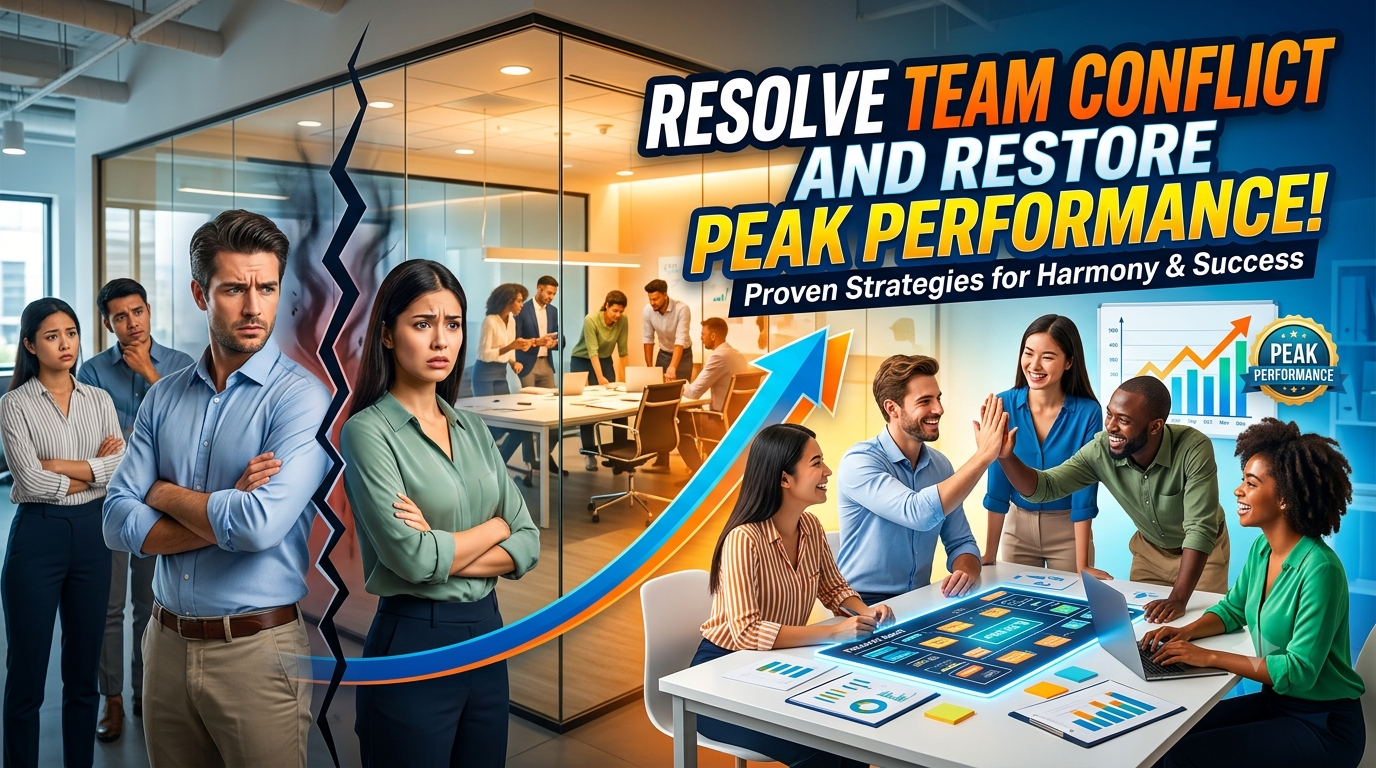
Healthy conflict enables teams to develop stronger ideas. Unhealthy conflict quietly drains energy, slows decisions, and ultimately contributes to missed targets. When tension starts to feel personal, political, or passive-aggressive, performance will deteriorate unless leaders intervene with clarity and skill.
This article outlines how to recognize when conflict is becoming harmful, how to stabilize performance in the midst of tension, and how to develop leaders who can turn friction into a source of learning rather than a lasting drag on results through approaches such as mindset coach training and conflict resolution training. At Arslan Larik & Company, work with global teams is grounded in shifting mindsets, not only behaviors, so that conflict becomes a catalyst for growth instead of a threat.
When Healthy Debate Becomes Harmful Conflict
Every high-performing team experiences disagreement. When disagreement is constructive, it produces sharp thinking, candid feedback, and a shared sense of commitment to common goals. Problems emerge when the focus shifts from the issue to the individual and people begin to keep score.
Productive tension sounds like, "Help me understand the risk in this idea," or, "We seem to have different assumptions; let us unpack them." Destructive conflict sounds like, "You always do this," or, "There is no point in speaking up," followed by eye rolls, silence, or side conversations. Innovation requires dissent, but it cannot thrive in an atmosphere of sarcasm and quiet resentment.
Through coaching, NLP, and hypnotherapy-based methodologies, Arslan Larik & Company supports leaders in transforming the internal patterns that drive these reactions. Leaders develop the ability to regulate their emotional state, examine assumptions, and maintain space for disagreement without resorting to blame.
The following sections explore how to identify early warning signs, diagnose the underlying source of conflict, stabilize performance, and build a culture in which leaders are equipped to work with tension in a disciplined, professional way.
Spotting Early Warning Signs Before Performance Declines
By the time performance metrics visibly decline, conflict has usually been present for some time. The earliest signals typically appear in day-to-day behavior long before they appear in formal measures.
Observe indicators such as:
- Conversations after formal meetings, where substantive views are expressed only informally
- Email exchanges that become increasingly lengthy, guarded, or defensive
- Side conversations, cliques, and inside jokes that exclude specific colleagues
- Sarcasm, eye-rolling, or comments that clearly land with an edge
- Persistent lateness, cameras turned off in virtual meetings, or minimal contribution in discussions
Performance-related signs are different but equally significant:
- Repeatedly missed deadlines without a clear external cause
- Rework on tasks that should have been clear the first time
- Slower decision cycles and more frequent escalation to senior leaders
- Ambiguity regarding ownership and accountability
- A compliance-driven "just get it done" mindset replacing thoughtful collaboration
The emotional climate also provides important clues. When psychological safety erodes, defensiveness, fatigue, and risk avoidance tend to increase, particularly in the presence of senior leaders. Individuals stop raising concerns, avoid admitting mistakes, and focus on self-protection.
Underlying these patterns are mindset dynamics, for example:
- Fixed thinking, such as "This is just how they are"
- Blame narratives, in which one person or team becomes the "villain"
- Identity-based conflict, such as "us vs. them" between functions or organizational levels
These are the types of patterns that coaching and NLP-based tools address effectively, because they focus on the beliefs and narratives that shape behavior, not solely on observable actions.
Understanding the Real Source of Team Conflict
When tension is high, attention often centers on the most visible incident. Two individuals may clash in a meeting, creating the impression that the issue is purely interpersonal. In many cases, that visible confrontation is only the surface expression of a deeper problem.
Common underlying drivers include:
- Conflicting priorities between functions or business units
- Unclear roles or overlapping responsibilities
- Misaligned incentives that reward different or competing outcomes
- Ambiguous decision rights, so no one is certain who holds final authority
Mindset-related triggers compound these structural issues. Internal narratives such as, "They never listen to me," or, "My perspective does not matter," amplify minor disagreements into perceived disrespect. Once such narratives are established, almost any behavior can be interpreted as a personal slight.
To surface what is genuinely occurring beneath the surface, leaders can:
- Conduct brief, focused one-to-one conversations to listen for recurring themes
- Use simple, anonymous pulse checks to identify where trust is low
- Facilitate structured discussions in which norms, expectations, and assumptions are explicitly articulated
Tools commonly taught in mindset coach training and conflict resolution training, such as reframing, state management, and perspective shifting, support leaders in understanding how individuals interpret one another’s behavior. When those interpretations shift, new options for resolution become available.
Stabilizing Performance During Active Conflict
When conflict is already affecting performance, it is important to stabilize operations while addressing underlying issues. In this phase, clear structure and composed, deliberate leadership are essential.
Begin with psychological safety. Establish a small set of non-negotiable ground rules for communication. Reaffirm shared objectives so that team members remain oriented toward collective outcomes, and agree on interim decision protocols to prevent critical work from stalling while tensions are addressed.
Next, separate individuals from the issues at hand. Instead of character labels such as "difficult" or "uncooperative," focus on specific behaviors and their impact. For example, "When status updates are delayed, the team is forced to re-plan at the end of the week" keeps attention on actions and outcomes rather than personal traits.
It is also important to reset working agreements:
- Clarify roles, responsibilities, and handoffs
- Revisit timelines and capacity with realism
- Ask each participant to articulate, in their own words, what success looks like
Leadership presence is a critical factor. A leader’s emotional state sets the tone for the group. If the leader appears tense, defensive, or disengaged, the team is likely to reflect that state. Mindset-focused coaching capabilities enable leaders to regulate their emotions, remain curious in the face of challenge, and communicate with calm clarity. That steadiness often allows a difficult discussion to become productive.
Using Conflict as a Catalyst for Growth
Once immediate disruption is contained, conflict can be treated as a source of valuable information. Recurring disagreements often highlight important issues in systems, culture, or clarity.
Leaders can:
- Treat conflict as data about what is confusing, misaligned, or under-specified
- Develop a shared language for raising concerns and challenging ideas
- Introduce clear frameworks for resolving deadlock so that decisions are not improvised under pressure
Short, blame-free retrospectives following significant conflicts can shift how teams perceive these moments. Instead of asking, "Who caused this?" focus shifts to questions such as, "What assumptions did we make?" and, "What will we do differently next time?" Over time, teams learn to view conflict not as failure, but as structured feedback.
Investing in internal capability through conflict resolution training and mindset coach training reduces reliance on external intervention whenever tensions rise. Leaders, HR partners, and internal coaches become more skilled at guiding difficult conversations, reframing challenging situations, and protecting performance while individuals work through disagreement.
Building a Culture That Minimizes Destructive Conflict
Sustainable success depends on building a culture in which destructive conflict struggles to take hold. This does not mean avoiding disagreement; it means creating conditions in which tension is addressed early and constructively.
Practices that support this include:
- Normalizing regular, two-way feedback rather than reserving it for infrequent reviews
- Holding cross-functional check-ins where teams surface friction before it escalates
- Creating space in meetings for raising concerns without individuals being labeled as negative
These habits should be explicitly linked to organizational values. If respect is a stated value, define the behaviors that demonstrate respect in meetings, email, and decision making. If ownership is a value, clarify what responsible behavior looks like when conflict arises.
At Arslan Larik & Company, there is clear evidence of impact when organizations develop internal change agents in coaching, NLP, and mindset work. These individuals help teams recalibrate when unhelpful patterns return, so the culture continues to learn rather than repeat the same disputes.
When these practices are integrated into performance management, leadership development, and onboarding, healthy conflict and constructive challenge become part of everyday operations, rather than an occasional initiative that diminishes when pressure increases.
From Conflict to High Performance: A Strategic Decision
Transitioning from avoiding conflict to using it as a structured source of learning is a strategic choice. It safeguards performance, strengthens relationships, and releases energy that would otherwise be spent on politics and avoidance.
A practical starting point is structured self-reflection by leaders:
- Where is conflict quietly slowing work today?
- What narratives arise about the team when conflict appears?
- How do personal reactions in tense moments influence what others feel able to express?
From this reflection, leaders can initiate a focused team discussion on a recurring tension, adjust individual conflict habits, or explore how mindset-focused coaching and conflict resolution training can support the leadership cohort. At Arslan Larik & Company, the work is centered on helping individuals and organizations transform how they think, relate, and perform, so that conflict becomes a pathway to higher performance rather than a barrier.
Begin Your Mindset Coach Journey With Confidence
If you are ready to work at a deeper level with clients and lead from the front of the room, our mindset coach training is designed to help you get there. At Arslan Larik and Company, we focus on practical tools, real-world application, and the inner work that makes your coaching truly effective. Explore how this program can fit your goals, and if you have questions or need guidance choosing the right path, feel free to contact us.